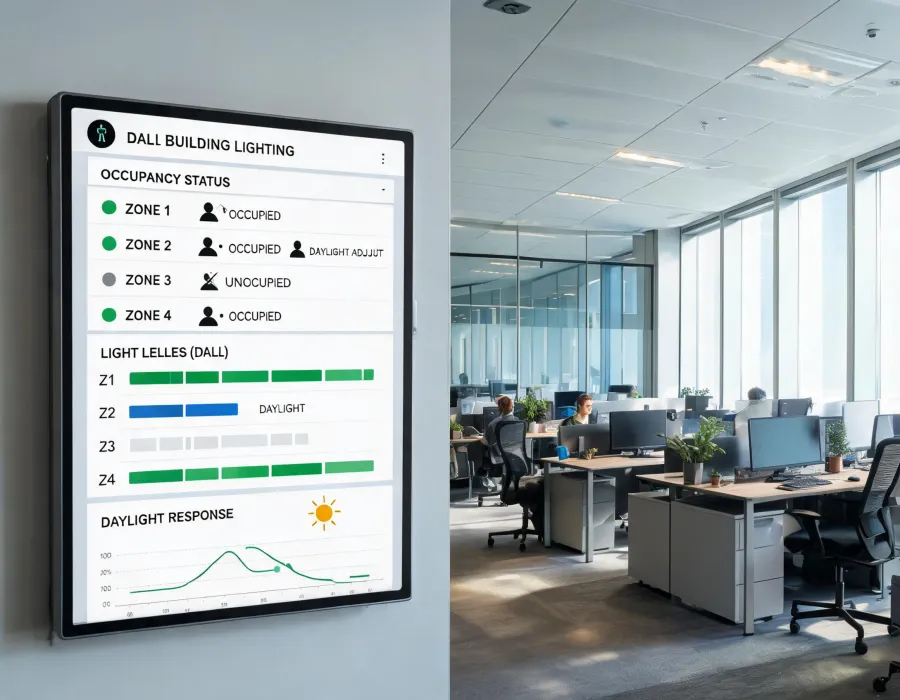
Connected architecture: DALI-2 · 0-10V · occupancy · daylight harvesting

SMART CONTROLS

iGuzzini connects sensing, scenes and energy intent

A control system should express how a building is used. We organize protocol, zoning, commissioning and operational feedback into an architecture the project team can understand and maintain.

Plan a Controls Workshop
Connected lighting controls dashboard for an architectural interior
DALI-2: onlineOccupancy: zonedDaylight: calibrated

ARCHITECTURE FILTERS

Start with the interface and responsibility model

Protocol selection affects wiring, addressing, diagnostics and who owns changes after handover. These pathways can coexist, but their boundaries must be explicit.

DALI-2

Addressable luminaires, input devices and application controllers support granular zoning and standardized device roles. Confirm topology, addressing responsibility and emergency integration.

Best discussed for:Flexible interiors · monitored systems · scene-rich projects

0-10V

A familiar analog dimming approach with straightforward local control. Circuit grouping and low-voltage wiring define flexibility, while diagnostics are generally more limited.

Best discussed for:Clear zones · retrofit constraints · simple sequences

DMX

Fast channel control can serve dynamic facade, event and color-changing applications. Network design, scene programming and operator access require disciplined coordination.

Best discussed for:Facade media · performance spaces · dynamic RGBW

Wireless layers

Wireless sensors or gateways can reduce control wiring in selected contexts. Radio planning, cybersecurity, battery strategy and long-term platform support remain design questions.

Best discussed for:Phased retrofit · flexible tenancy · targeted sensing

A control narrative becomes a commissioned sequence

Centralized management offers a coherent supervisory view; distributed control can improve local resilience and flexibility. The right answer depends on scale, change frequency, operational capability and failure strategy.

Before procurement, define who supplies sensors, gateways and application controllers; who addresses devices; who calibrates thresholds; and which team receives the final backups and user permissions.

SenseOccupancy state, daylight contribution and local input are mapped to real zones.
DecideSequences define setpoints, timeouts, fades, overrides and fallback behavior.
ActDrivers and luminaires respond within verified dimming and scene requirements.
VerifyFunctional tests confirm each state, device response and override path.
HandoverSchedules, addresses, backups, credentials and training remain with the operator.

COMMISSIONING QUESTIONS

Resolve ambiguity before it becomes site rework

During design development, before luminaire schedules and control packages diverge. It should describe occupied, vacant, daylight, after-hours and emergency behavior in language all disciplines can review.

No. Sensor location, calibration, zoning, façade conditions and user overrides affect results. Savings depend on commissioning and operation as much as the device specification.

Device schedules, addresses, zone and scene maps, sequence descriptions, setpoints, software backups, access roles, test records and a clear support path for future adjustments.

Commission the intent, not just the devices

Bring the reflected ceiling plan, sequence of operations and responsibility matrix. We will help expose protocol and handover gaps.